Reformer vs Mat Pilates: Which Is Better, and Is Reformer Worth the Money?
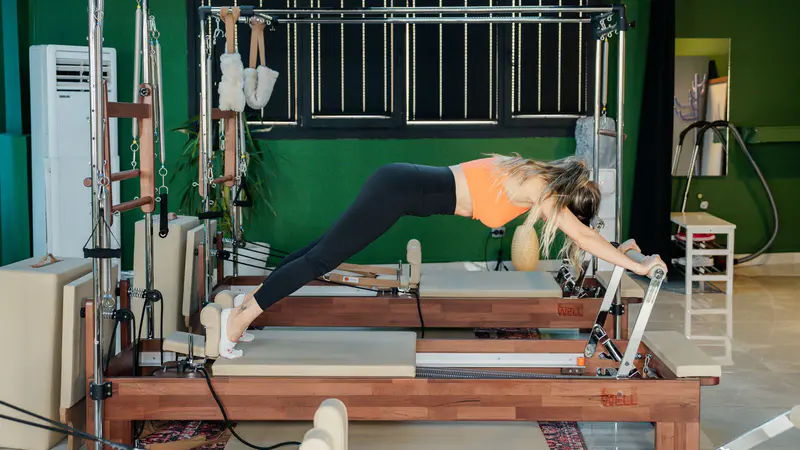
Reformer and mat Pilates are both effective, and for most people the better one is the one you will do consistently. Mat Pilates uses your body weight and is cheap or free. Reformer Pilates uses a sliding carriage with springs, which adds adjustable resistance and support and makes it easier to progress, but a UK group class typically costs £20 to £45. In the only good-quality trial comparing them directly, both helped chronic low back pain, and the reformer group did slightly better on disability six months later.
The key insight: the reformer is not magic. Its real advantages are springs you can make heavier as you get stronger, and support that helps beginners and people with injuries move well. You can get much of the same benefit on a mat if you make it progressively harder.
Below: how the two differ, what the research shows, what each costs, and how to choose.
What Is the Difference?
Both come from the method Joseph Pilates developed in the early 20th century, built on core control, breathing, alignment and precise, controlled movement.
| Mat Pilates | Reformer Pilates | |
|---|---|---|
| Equipment | A mat, sometimes small props like bands, rings or balls | A reformer: a sliding carriage, springs, straps and a footbar |
| Resistance | Your body weight | Adjustable springs, plus body weight |
| Support | None, you control every movement yourself | The machine can assist as well as resist |
| Class size | Often larger, limited only by floor space | Usually small, limited by the number of machines |
| Typical cost (UK) | Free at home; gym and community classes are usually much cheaper than reformer | Around £20 to £45 a group class; £70 to £200 for a private session |
| Where | Anywhere | A studio |
| Best for | Building control, doing it at home, tight budgets | Progressive resistance, rehab support, variety |
Reformer prices are from Which?. Prices vary widely by studio and area, so check locally.
Mat work is often described as harder for beginners than reformer work, because nothing helps you. On a mat, a roll-up relies entirely on your own abdominal control. On a reformer, springs can assist you through the hardest part of the movement.
What Does the Research Say?
Pilates and back pain
A Cochrane review of 10 randomised trials with 510 people found that Pilates reduced pain and disability in chronic low back pain compared with minimal treatment, with low to moderate quality evidence. It was not clearly better than other types of exercise, which tells you Pilates is a good option rather than the only one. Side effects were rare and mostly mild muscle soreness.
Reformer vs mat, head to head
The best direct comparison is a 2014 randomised trial in Physical Therapy. Eighty-six adults with chronic low back pain were split into mat Pilates or equipment-based Pilates, twice a week for six weeks.
- Both groups improved in pain and disability.
- At six months, the equipment group had less disability and less fear of movement than the mat group.
- There was no difference in pain between the groups.
One trial is not the final word, and the differences were modest. But it fits what instructors see: the support of the machine helps people with pain move with more confidence.
Strength and posture
Studies of both forms generally find improvements in core endurance, flexibility and balance. Neither is a replacement for heavier strength training if your goal is bone density or building significant muscle, which matters especially in perimenopause and beyond. Think of Pilates as an excellent complement to lifting, not a substitute.
Is Reformer Pilates Worth the Money?
It can be, if you can afford it consistently. Reformer is worth paying for if you:
- Are recovering from an injury or have back pain and want support
- Find mat work frustrating because you cannot yet control the movements
- Want resistance that increases steadily as you get stronger
- Like small classes with more instructor attention
Mat Pilates is the better choice if you:
- Want to train at home or while travelling
- Are on a tight budget: at £25 a class, three reformer classes a week comes to over £300 a month
- Want to build the core control that makes every other exercise better
- Already lift weights and want a mobility and control session alongside
A sensible middle path: one reformer class a week for technique and variety, plus one or two mat sessions at home.
How to Make Mat Pilates Harder
The reformer's big advantage is easy progression. You can get the same effect on a mat, using the principle of progressive overload:
- Slow down. Take three to four seconds on the lowering phase of each move.
- Add a resistance band to leg circles, side-lying work and bridges.
- Lengthen the lever. Straighten your legs or reach your arms overhead to make core work harder.
- Add holds. Pause at the hardest point of a movement for two to three breaths.
- Use small weights for arm series, such as 1kg to 2kg dumbbells.
A Simple 20-Minute Mat Session
| Exercise | Reps | Focus |
|---|---|---|
| Breathing and pelvic tilts | 8 | Find a neutral spine |
| The hundred (modified, knees bent) | 100 counts | Core endurance |
| Single-leg stretch | 8 each side | Core control |
| Bridge with slow roll-down | 8 | Glutes and spinal mobility |
| Side-lying leg series | 10 each side | Hips |
| Swimming | 30 seconds | Back extensors |
| Spine stretch forward | 6 | Mobility |
| Child's pose and breathing | 1 minute | Cool down |
If you want to understand the method more deeply, our course on Pilates foundations, history and methods covers where it came from and why it works. For an even gentler practice on recovery days, see our guide to somatic exercise.
Who Should Check First
Pilates is suitable for most people, but speak to a GP or physiotherapist first if you have back pain with numbness, weakness or bladder or bowel changes, have had recent surgery, are pregnant and new to Pilates, or have osteoporosis, since some deep spinal flexion moves may need adapting.
How Visionary Can Help
Visionary builds a weekly plan around your goal, so Pilates sits alongside strength, walking and recovery instead of on top of everything else. Tell it how many days you have and what you enjoy, and the plan adapts as your week changes. The Learn library includes expert-led courses on Pilates foundations and holistic mobility, and nutrition and sleep are part of the same plan.
Start your 7-day free trial and build a week that fits Pilates in properly.
FAQ
Is reformer Pilates better than mat Pilates?
Not necessarily. Both improve core strength, flexibility and back pain. Reformer Pilates adds adjustable spring resistance and support, which makes it easier to progress and can help people with injuries. In one randomised trial, equipment-based Pilates gave slightly better results for disability at six months, with no difference in pain.
Is mat Pilates harder than reformer?
For beginners, mat Pilates often feels harder, because there is no machine to assist you and you rely entirely on your own control. Reformer can be harder in a different way, because the springs add resistance.
How much does reformer Pilates cost in the UK?
A group reformer class typically costs around £20 to £45, depending on the studio and location. Private sessions usually cost £70 to £200. Class packs and memberships bring the price per class down.
Can you build muscle with Pilates?
Pilates builds muscular endurance and some strength, especially in the core, glutes and hips, and reformer springs allow more resistance than a mat. For significant muscle growth and bone density, combine it with traditional strength training.
How often should I do Pilates?
Two to three sessions a week is enough for most people to notice improvements in core strength, posture and flexibility within a few weeks.
Is Pilates good for back pain?
A Cochrane review found Pilates reduces pain and disability in chronic low back pain compared with minimal treatment, although it is not clearly better than other forms of exercise. Choose the exercise you enjoy and will keep doing.
This article is for general information only and is not a substitute for personalised advice. If you have back pain with other symptoms, a recent injury or surgery, osteoporosis, or are pregnant, speak to your GP or a physiotherapist before starting Pilates.
Related articles
 FitnessHolistic HealthPersonalised Plans
Cycle Syncing: What the Evidence Actually Says
Does cycle syncing your workouts work? What research shows about training across the menstrual cycle, and a simpler, evidence-led approach.
11 Oct 2026 · Sophie Sparkes FitnessPersonalised PlansRecovery
What Is Hyrox? A 12-Week Plan for Your First Race
Hyrox explained: the format, the eight stations and a realistic 12-week beginner plan that builds running, strength and race-day fitness.
10 Oct 2026 · Ashton de Pontes FitnessHabitsLongevity
Inside Visionary Learn: How Expert-Led Courses Turn Fitness Knowledge Into Lasting Habits
Visionary Learn uses expert-led courses and practical resources to help you understand fitness, build sustainable habits, and stay consistent.
25 Sept 2026 · Sophie Sparkes